EN
EN


50Hz or 60Hz? What Happens If You Choose the Wrong Generator Frequency?
Why frequency matters for generator speed, motors, ATS systems and overseas project selection
When selecting a diesel or gas generator set, buyers usually start with kW or kVA, engine brand and price. But frequency is just as important. A generator configured for 50 Hz is not automatically interchangeable with a 60 Hz system, and the wrong frequency can affect motor speed, control systems and the compatibility of connected equipment.
For overseas projects, frequency should be confirmed together with voltage, phase and operating mode before the generator is quoted or built.
1. What Is the Difference Between 50Hz and 60Hz?
Frequency describes how many alternating-current cycles occur each second. A 50 Hz system completes 50 cycles per second, while a 60 Hz system completes 60.
For an AC generator, frequency is directly related to alternator pole count and rotational speed. For the 4-pole alternators commonly used in industrial generator sets:
|
Frequency |
4-pole synchronous speed |
Typical use |
|
50 Hz |
1,500 rpm |
Common across Europe, China, India, most of Africa and many other markets |
|
60 Hz |
1,800 rpm |
Common in North America and selected markets in Latin America, Asia and the Middle East |
The relationship is defined by synchronous speed: n = 120f / P, where n is rotational speed, f is frequency and P is the number of poles. This is why changing a generator from 50 Hz to 60 Hz is not simply a matter of changing a number on the controller.
2. 50Hz and 60Hz Around the World: Do Not Assume by Region
Most countries use one standard grid frequency, but the world cannot be divided accurately into only two regional blocks. There are important exceptions and a few markets where frequency varies by location.
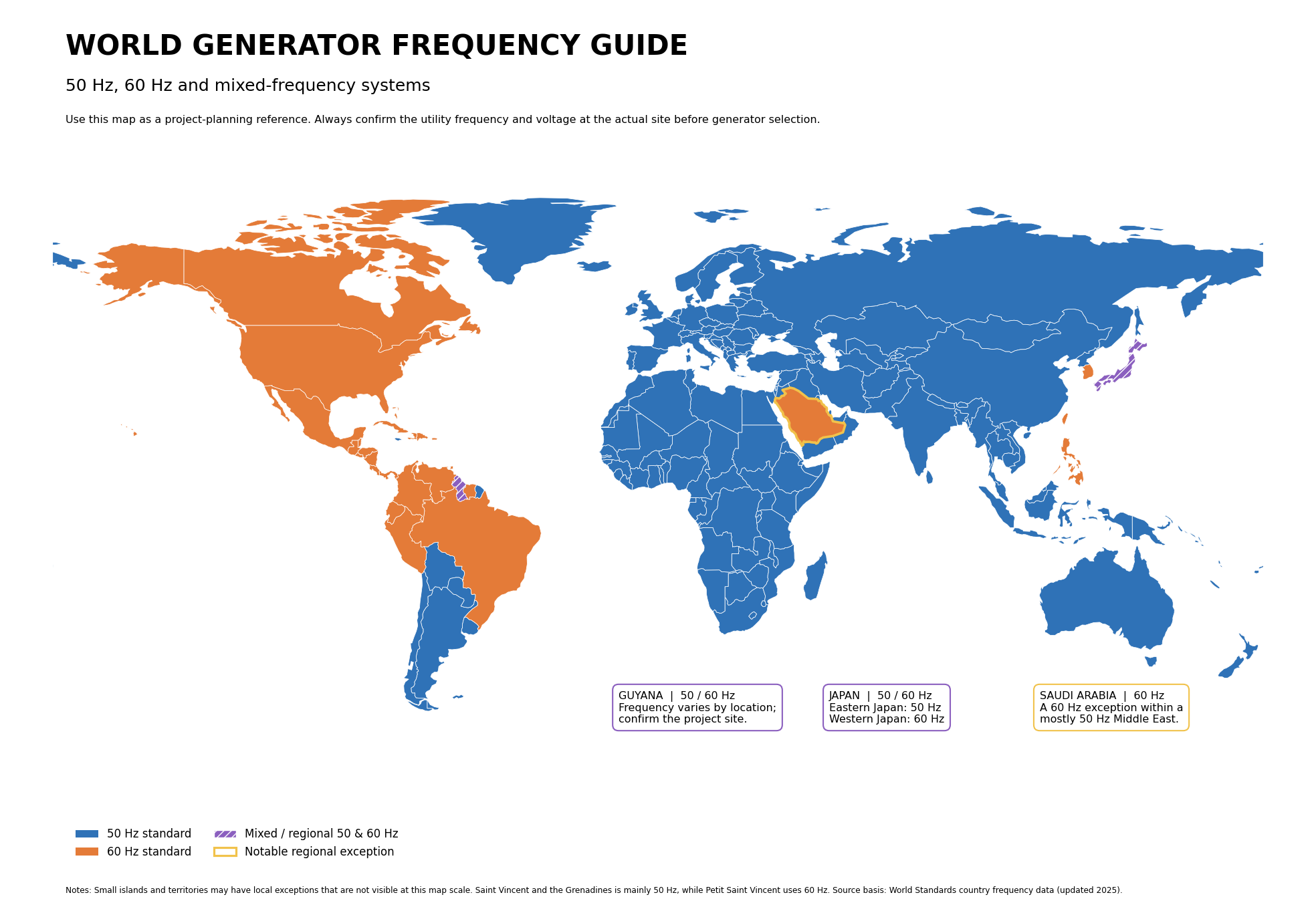
World generator frequency guide: 50 Hz, 60 Hz and mixed-frequency systems.
Important exceptions to remember
• Japan uses both frequencies: 50 Hz in eastern Japan and 60 Hz in western Japan.
• Guyana uses 50 Hz or 60 Hz depending on location, so the project site must be confirmed.
• Saudi Arabia uses 60 Hz. It is a notable exception in the Middle East, where neighboring Gulf and regional markets are generally 50 Hz.
• Some small islands and territories have local exceptions. For generator projects, the utility specification at the actual installation site should always take priority over a general country map.
For this reason, country-level frequency maps are useful for initial planning, but they should never replace the customer's site electrical data.
3. What Happens If the Wrong Frequency Is Selected?
Motor and driven-equipment speed can change
Induction motors, pumps, fans and compressors are frequency-sensitive. If a motor designed for 60 Hz is supplied at 50 Hz, its operating speed will generally decrease. If 50 Hz equipment is operated at 60 Hz, speed may increase unless the equipment is designed or controlled for both frequencies.
For pumps and fans, a speed change can also change flow, pressure and absorbed power. The actual effect depends on the motor, driven equipment and control method.
Voltage-to-frequency ratio and heating must be considered
Frequency should not be considered separately from voltage. For AC motors and magnetic equipment, the voltage-to-frequency (V/Hz) relationship affects magnetic flux and temperature rise. Supplying a different frequency without the correct voltage and equipment rating can lead to reduced torque, overheating or inefficient operation.
ATS, UPS and control systems may reject the source
In standby applications, an Automatic Transfer Switch (ATS) monitors both voltage and frequency. If the generator output is outside the programmed acceptance window, the ATS may block transfer or connected systems may reject the generator source. UPS systems, variable-frequency drives and other electronic loads may also have defined frequency limits.
A correct kVA rating does not guarantee compatibility
A 500 kVA generator can still be unsuitable if the project voltage, frequency, phase or operating mode is wrong. For example, 400 V / 50 Hz and 480 V / 60 Hz are common industrial configurations, but they are examples rather than universal rules. Voltage and frequency must be confirmed independently for each project.
4. Can a 50Hz Generator Be Changed to 60Hz?
Sometimes, but not always as a simple field adjustment. Changing frequency can require changes to engine speed, governor settings, AVR settings, alternator voltage configuration, control parameters and the ratings of auxiliary motors or fans. Engine and alternator power ratings may also differ at 1,500 rpm and 1,800 rpm.
If a project needs a different frequency from the generator's original configuration, the correct approach is to check the engine, alternator, controller and auxiliary equipment data before conversion.
5. What Information Should You Provide When Requesting a Generator Quote?
Instead of sending only “I need a 500 kVA generator,” provide the complete electrical and application requirements:
• Required power: kW or kVA
• Voltage
• Frequency: 50 Hz or 60 Hz
• Phase: single-phase or three-phase
• Prime / continuous / standby rating
• Application and major load types
• Large motor, pump or compressor starting requirements
• UPS, data center or other critical electronic loads, if applicable
• Installation altitude and maximum ambient temperature
Example: 500 kVA / 400 V / 50 Hz / 3-phase / prime power.
For another project, the requirement might be 500 kVA / 480 V / 60 Hz / 3-phase / standby power. The power rating is the same, but the generator configuration and connected-system requirements can be very different.
6. Final Check Before Generator Selection
Frequency may look like a small specification, but it affects the generator's operating speed and the compatibility of the entire electrical system. For overseas projects, confirm the actual site voltage and frequency before finalizing the generator configuration.
If you are selecting a diesel or gas generator set, send ASIA GENERATOR your required power, voltage, frequency, phase, operating mode and application details. Our team can help evaluate the appropriate configuration for your project.
Stay Updated with ASIA GENERATOR
Follow ASIA GENERATOR on LinkedIn for generator selection guides, technical insights, project case studies and product updates.
Project inquiry: [email protected]
Data note: World frequency references were checked against World Standards country data updated in 2025. Japan is 50/60 Hz by region; Guyana varies by location; Saudi Arabia is 230 V / 60 Hz.