EN
EN


Data Center Backup Generators: What AI Infrastructure Demands from Modern Generator Sets
AI infrastructure is changing the scale and expectations of data center power systems. The growth of high-density computing is increasing electricity demand, while new campuses are often being developed in markets where grid capacity, interconnection lead times and power quality are already under pressure.
The International Energy Agency (IEA) projects that global data center electricity consumption will roughly double from about 485 TWh in 2025 to around 950 TWh in 2030. AI-focused data centers are expected to grow even faster. For operators and developers, this makes backup power design a core infrastructure decision rather than an afterthought.
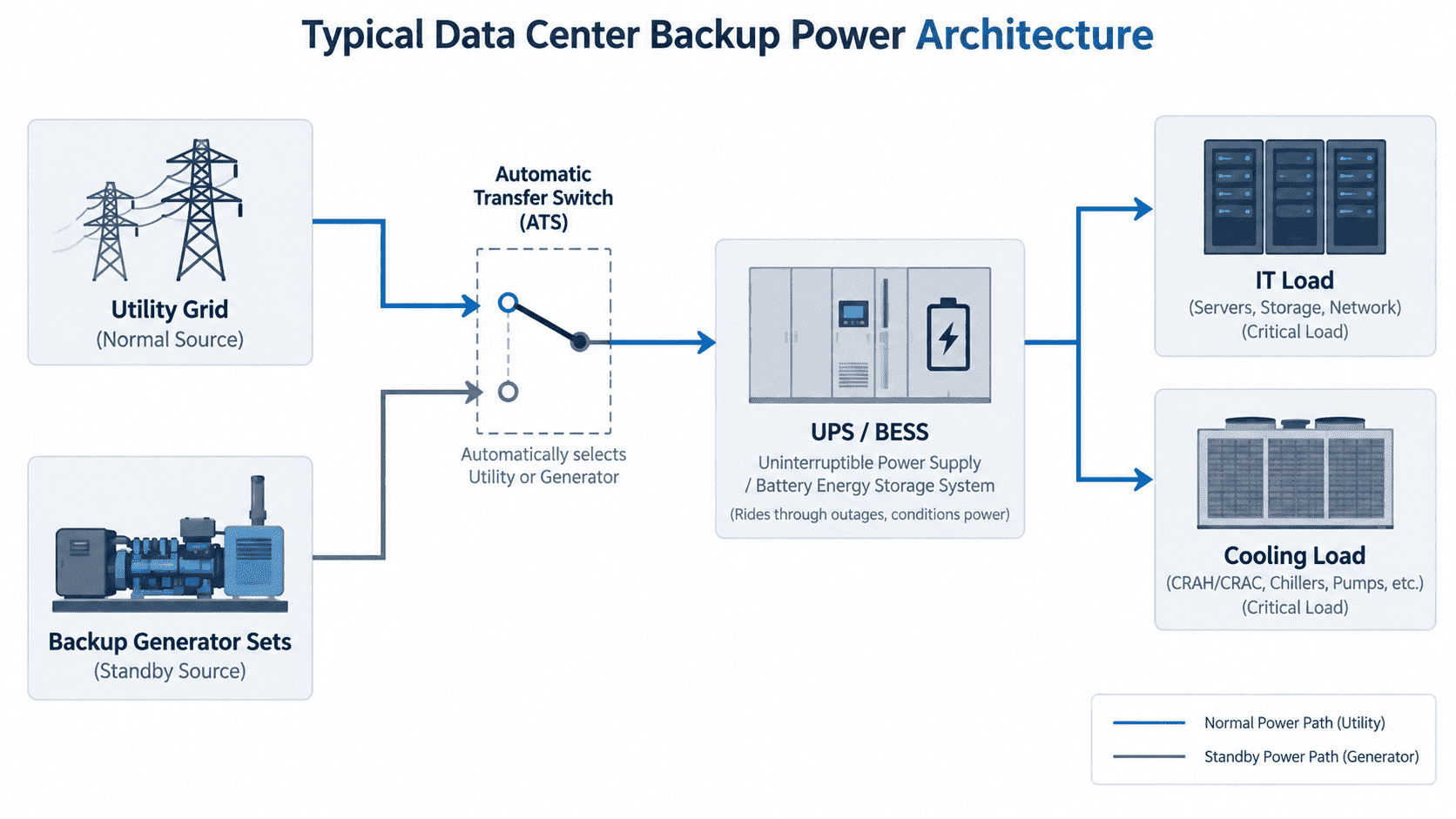
Data center backup power architecture with utility grid, UPS, generator sets, IT load and cooling load
A MARKET SIGNAL: THE GENERAC–AMAZON AGREEMENT
On September 16, 2026, Generac disclosed a long-term supply agreement with Amazon for backup power generators serving Amazon data centers. Generac said initial deliveries are expected to total approximately US$2.4 billion in 2027 and 2028. A related warrant structure includes additional vesting tied to aggregate gross payments for backup generators, up to US$8 billion.
The US$8 billion figure should not be read as a confirmed US$8 billion purchase commitment. It is the upper payment threshold linked to the warrant vesting mechanism. Even so, the disclosed scale of the initial deliveries shows how strategically important backup generation has become for hyperscale data center development.
Source: Generac Holdings Inc.
1. Why AI Data Centers Still Need Generator Backup
A modern data center normally relies on several layers of power protection. Utility power supplies the facility during normal operation. UPS systems and battery energy storage can bridge short interruptions and support power quality. Backup generator sets provide longer-duration power when the grid is unavailable or unstable.
These technologies therefore perform different roles. Batteries are not simply a replacement for generator sets, and generator sets are not a replacement for UPS systems. In critical facilities, they are designed as part of one coordinated power architecture.
AI workloads make this coordination increasingly important. High-density computing clusters can create large and rapidly changing electrical loads, while the cooling system, pumps, controls and networking equipment must remain powered at the same time. The generator system therefore needs to be selected around the full facility load profile—not only the nameplate IT load.
2. What Makes a Data Center Generator Different?
Fast Start and Strong Transient Response
When utility power fails, the generator must start, stabilize and accept load within the time allowed by the facility’s UPS and transfer strategy. Sudden load acceptance can cause voltage and frequency deviations, so engine-generator matching, alternator sizing, control logic and load-step performance all need to be considered during system design.
Multi-Unit Paralleling and Redundancy
Large data centers rarely depend on a single generator. N+1, 2N and other redundant architectures may require multiple generator sets to synchronize, share active and reactive loads, isolate a failed unit and continue operating without compromising the remaining system. The paralleling switchgear and control philosophy are therefore just as important as the generator set itself.
Reliable Standby Operation
Data center generators may spend long periods on standby and then be expected to start immediately under emergency conditions. Preventive maintenance, battery and starting-system health, fuel quality, coolant condition, jacket-water heating and routine load testing all affect emergency readiness.
Integration with Facility Controls
For modern data centers, generator controls may need to interface with ATS, paralleling switchgear, BMS or SCADA systems. Remote status monitoring, alarms, event logging and communication protocols should be defined early so the backup power system can be integrated into the facility’s operating strategy.
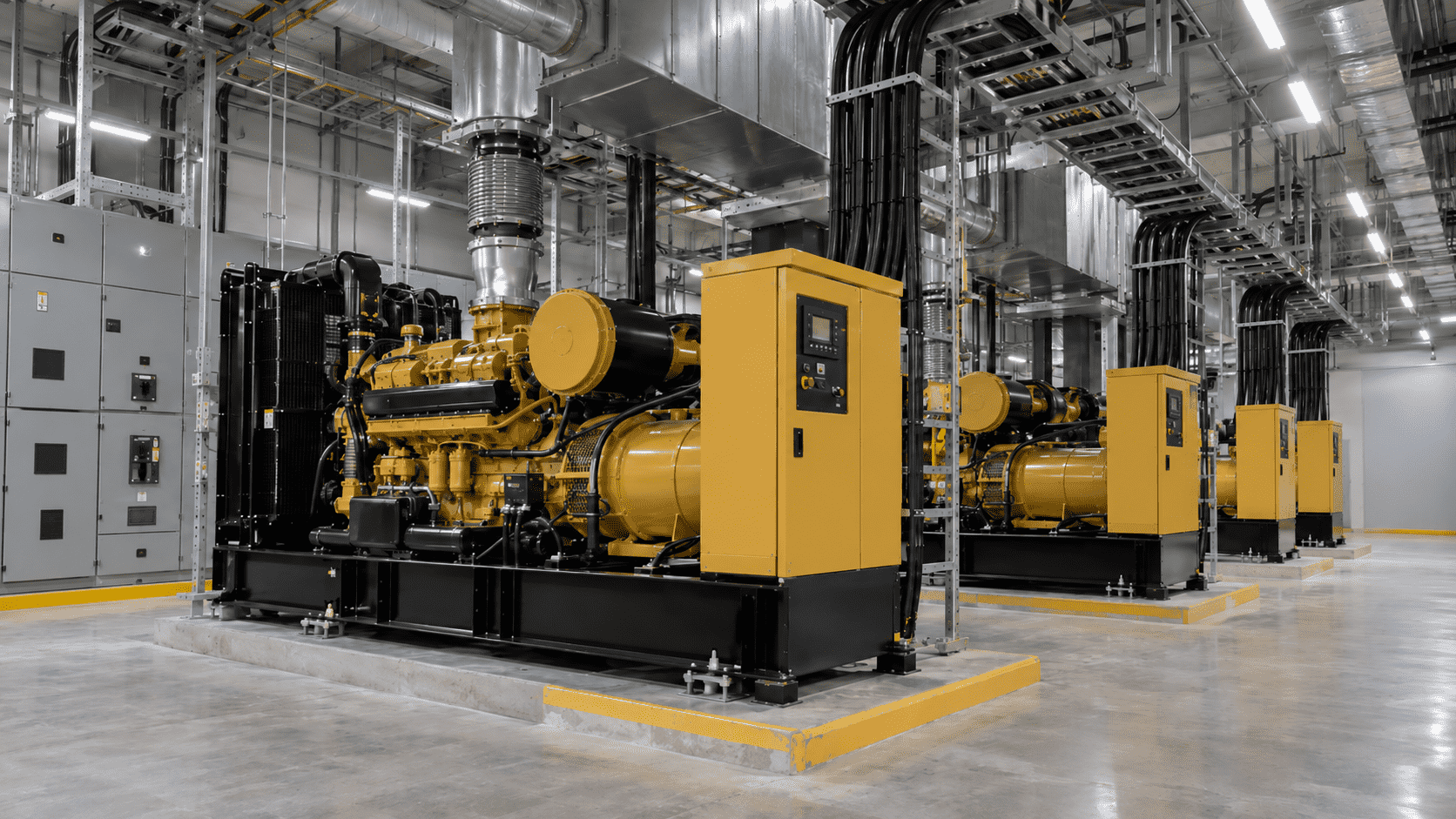
Multiple diesel generator sets installed in a modern data center backup power facility
3. How to Size a Backup Generator for an AI Data Center
Selecting a generator by matching a single kVA figure is rarely enough for a large data center. A proper sizing study should consider both steady-state demand and transient behavior.
- IT equipment load and expected future rack-density growth
- Cooling-system demand, including chillers or dry coolers, pumps, fans and controls
- UPS losses and other electrical conversion losses
- Motor starting currents and other step loads
- Redundancy strategy, such as N+1 or 2N
- Required runtime and fuel storage strategy
- Ambient temperature and installation altitude, which can affect engine and cooling performance
- Voltage, frequency and local electrical standards
- Available installation space, ventilation, exhaust routing and acoustic limits
- Future expansion and whether additional generator sets may be paralleled later
For high-density AI facilities, the cooling load deserves particular attention. Cooling equipment is part of the emergency load, and its starting characteristics can materially affect generator sizing. This is one reason a project-specific load list is more useful than selecting only from the data center’s headline MW capacity.
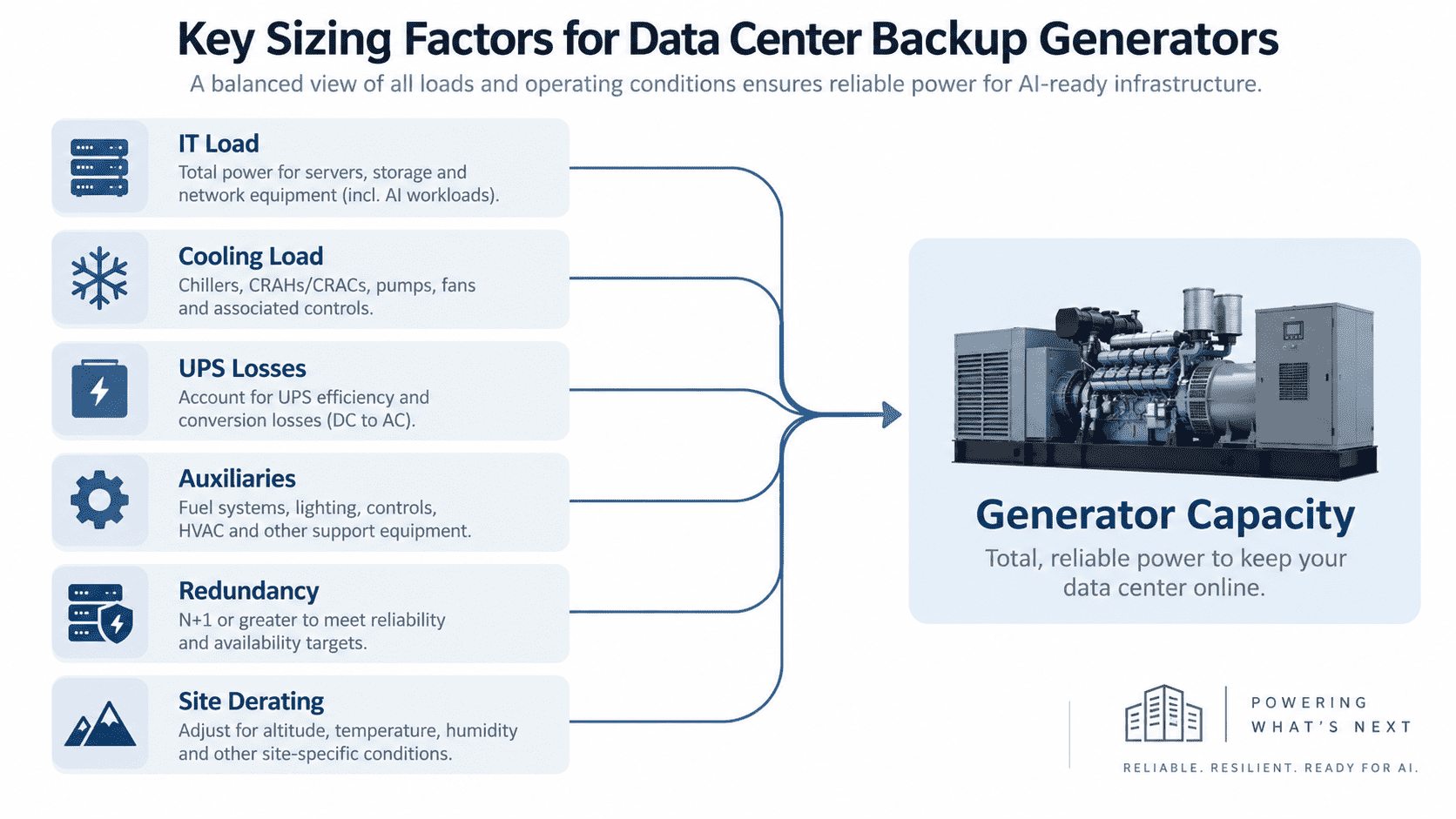
Key sizing factors for data center backup generators, including IT load, cooling load, UPS losses, redundancy and site conditions
4. Diesel, Gas or Hybrid Backup Power?
There is no single fuel choice that fits every data center. The decision depends on the site, local fuel infrastructure, emissions requirements, operating philosophy and expected runtime.
|
Option |
Typical Strengths |
Points to Evaluate |
Typical Use |
|
Diesel generator sets |
High power density, established technology, fast emergency response |
Fuel storage, emissions rules, maintenance and runtime requirements |
Standby/emergency power for a wide range of data centers |
|
Gas generator sets |
Potentially lower local emissions and access to pipeline fuel where available |
Gas supply reliability, pressure, permitting and project-specific response requirements |
Sites with dependable gas infrastructure or longer operating profiles |
|
Hybrid architectures |
Can combine generator sets with UPS/BESS and other energy resources |
More complex controls, protection coordination and operating strategy |
Projects seeking flexible resilience and energy-management options |
For mission-critical projects, fuel choice should be evaluated together with redundancy, start sequence, site infrastructure and local regulatory requirements rather than treated as a standalone equipment decision.
5. How Asia Generator Supports Data Center Projects
Asia Generator supplies diesel and gas generator solutions for industrial and critical-power applications. For data center projects, configurations can be developed around the project’s required capacity, voltage and frequency, redundancy strategy, site conditions and control requirements.
- High-capacity diesel and gas generator options for standby and project-specific power applications
- Generator configuration based on voltage, frequency, ambient temperature and altitude
- Multi-unit project support where paralleling and redundancy are required
- ATS, monitoring and control options according to project requirements
- Cooling-system configuration coordinated with engine and site conditions
- Containerized, open-type or application-specific packaging options where applicable
- Technical review based on project load information before final equipment selection
The key principle is simple: a data center generator should be selected around the actual operating architecture, not only around a nominal kVA rating.
Planning a Data Center Backup Power Project?
When preparing an inquiry, the following information will help the technical team review the project more efficiently:
- Required standby/prime capacity or detailed load list
- Voltage and frequency
- Number of generator sets and redundancy requirement
- Diesel or gas preference
- Ambient temperature and altitude
- Required runtime
- Installation type and available space
- Noise or emissions requirements
- ATS/paralleling/BMS integration requirements
Send your project requirements to Asia Generator for a configuration review and generator selection proposal.
FAQ
Why do AI data centers still use backup generators if they have UPS batteries?
UPS systems and batteries provide immediate bridge power and power-quality support, while generator sets are typically used to sustain the facility during longer grid outages. In critical facilities, the two systems are designed to work together.
How do you size a generator for a data center?
Sizing should consider the full emergency load, including IT equipment, cooling systems, UPS losses, pumps, fans and other auxiliaries. Transient loads, redundancy, ambient temperature, altitude and future expansion should also be included.
What is N+1 redundancy for data center generators?
N+1 means the site has the number of generator sets required to support the design load (N), plus one additional unit. The exact redundancy strategy depends on the facility design and may also use 2N or other architectures.
Are diesel or gas generators better for data centers?
Both can be suitable. Diesel remains widely used for emergency standby power because of its established performance and power density. Gas may be attractive where reliable fuel infrastructure and project conditions support it. The final choice depends on the site, runtime, emissions rules and resilience strategy.
Can multiple generator sets operate in parallel for a large data center?
Yes. Large facilities commonly use multiple generator sets with paralleling controls and switchgear. The system must be engineered for synchronization, load sharing, protection coordination and fault isolation.
What information should I provide when requesting a data center generator quotation?
Provide the required capacity or load list, voltage, frequency, redundancy requirement, fuel type, ambient temperature, altitude, runtime, installation conditions, noise/emissions requirements and any ATS, paralleling or BMS/SCADA integration needs.
Does the Generac–Amazon agreement mean Amazon has committed to buy US$8 billion of generators?
No. Generac disclosed that initial deliveries are expected to total about US$2.4 billion in 2027 and 2028. The US$8 billion figure is the upper aggregate-payment threshold tied to the vesting of a related warrant, not a disclosed firm purchase commitment for that full amount.
Recommended Internal Links & Image ALT Text
|
Item |
Destination |
Suggested Anchor |
|
Internal link 1 |
Diesel Generator Sets product category |
Anchor: diesel generator sets |
|
Internal link 2 |
Gas Generator Sets product category |
Anchor: gas generator sets |
|
Internal link 3 |
Data Center application page (if available) |
Anchor: data center backup power solutions |
|
Internal link 4 |
Relevant generator case study |
Anchor: generator project case study |
- Large backup generator sets installed for data center power infrastructure
- Data center backup power architecture with UPS and generator sets
- Multiple generator sets configured for redundant data center backup power
- AI data center generator sizing factors including IT and cooling loads
- Asia Generator large-capacity generator set for critical power applications